
Tech Insights / Professional Column
From Pit to Podium: How Gator Motorsports Unlocked 137 km of Testing with the ADG-L
2026/06/29View

2025/08/25
Although AC Power Source and AC Power Supply are often used interchangeably, they serve different roles.
An AC Power Supply is designed for stable power delivery, while an AC Power Source—specifically a Programmable AC Power Source—is a sophisticated testing instrument. Unlike standard supplies, it allows precise control over voltage, frequency, and waveforms to simulate real-world grid disturbances.
For product validation and compliance testing (e.g., IEC standards), an AC Power Source offers superior flexibility and accuracy. By providing advanced features like PLD simulation, Preen helps manufacturers ensure their products remain reliable under the diverse and unstable electrical conditions found globally.
AC power, short for alternating current, is a widely used form of electricity that flows by periodically reversing direction and changing magnitude. It typically appears as a sinusoidal waveform and is the default electrical format for most residential and commercial environments.
Alternating Current (AC) power is fundamental to modern electrical systems, characterized by its periodically reversing direction and changing magnitude. The core principle behind AC generation is electromagnetic induction, where a conductor (like a coil of wire) moves through a magnetic field, or a magnetic field changes around a conductor. This motion induces an electromotive force (EMF), or voltage, which drives the current.
In a typical AC generator (alternator), a coil rotates within a stationary magnetic field. As the coil spins, the magnetic flux passing through it continuously changes, inducing a voltage that varies sinusoidally. This results in the characteristic sinusoidal waveform, where voltage and current rise from zero to a peak in one direction, return to zero, then rise to a peak in the opposite direction, and finally return to zero, completing one cycle. The frequency of AC power (e.g., 50 Hz or 60 Hz) indicates how many such cycles occur per second.
A key advantage of AC is its ease of voltage transformation using transformers. These devices efficiently step up or step down AC voltage levels, making long-distance power transmission at high voltages (to minimize energy loss) and local distribution at lower, safer voltages practical and cost-effective. This ability to easily change voltage levels is crucial for the widespread adoption and efficiency of AC power grids.
An AC power source (also known as an AC power supply) is a device that delivers stable alternating current to other equipment. It is particularly crucial for sensitive or precision devices that cannot tolerate voltage fluctuations from standard grid power. These instruments require a consistent and controlled power input, which an AC source ensures by adjusting the voltage or frequency according to the device's needs.
Once the functional differences are understood, equipment selection can be aligned more easily with real-world use cases:
Identifying the application scenario first helps avoid over-specification while ensuring the selected solution—whether it’s a compact AFV-P or a high-power PAS system—meets actual testing and operational
The AC power supply converts standard AC grid input into the desired output format, providing a stable power condition across various countries and applications. It also supports testing environments by simulating scenarios such as voltage sags, surges, harmonics, and momentary shutdowns, which help verify the resilience and reliability of the Device Under Test (DUT).
To summarize, an AC power source must fulfill three core functions:
After determining the appropriate equipment type, several technical factors should be evaluated during selection:
Considering these factors early in the evaluation process helps engineers and purchasing teams select solutions that align closely with operational and testing objectives.
Programmable AC power sources are sophisticated instruments designed to offer unparalleled control over electrical output, making them indispensable for advanced testing and simulation. Unlike conventional AC power supplies that merely provide stable power, programmable versions allow users to precisely manipulate voltage, frequency, phase, and waveform characteristics. This granular control is crucial for simulating a wide array of real-world grid conditions and electrical anomalies, which is vital for ensuring product reliability and compliance.
Key simulation capabilities include:
These advanced simulation features are critical across various stages of product lifecycle:
Programmable AC sources provide the necessary precision and repeatability to pass these critical regulatory tests, facilitating global market access.
By enabling comprehensive and repeatable testing scenarios, programmable AC power sources empower manufacturers to develop higher quality, more reliable, and globally compliant products.
A single-phase AC power supply routes current through one live wire and a neutral wire. It is commonly used in households and office applications where the power demands are relatively low. Many everyday appliances like fans and coolers operate effectively on single-phase systems due to their simple requirements and compatibility with non-polarized AC voltage.
A three-phase AC power source involves three conductors with a 120° phase difference. It offers a more efficient and cost-effective solution for high-power transmission. These power supplies are preferred in industrial environments to power motors, compressors, and heaters. Preen’s AFV+ series, for example, allows users to configure balanced or independent voltages for advanced applications, making it ideal for regions with varying power standards.
AC power supplies find applications across a wide range of fields. Preen provides reliable and versatile AC power solutions, from single-phase to high-capacity three-phase systems, designed to meet diverse testing and application needs.
AFV-P Series High Performance Programmable AC Power SourceAFV+ Series High Power Programmable AC Power SourceAFV Series High Power Programmable AC Power SourcePAS/PFV Series Regenerative Grid SimulatorAFC Series AC Power Source / Frequency ConverterAMV/AMF Series 400Hz Power Supply / Ground Power Unit
Preen’s AC Power Product Lineup
| AC Power Source Product Name | Image | Features | Output Power | Output Voltage | Output Frequency | THD | Load Regulation | Efficiency | Operational Temperature | IP Level | Overload Capacity | Crest Factor | Inrush Current | Response Time | DC Output Voltage | Remote Interface | Weight | Certification |
|---|---|---|---|---|---|---|---|---|---|---|---|---|---|---|---|---|---|---|
| AFV-P Series High Performance Programmable AC Power Source | 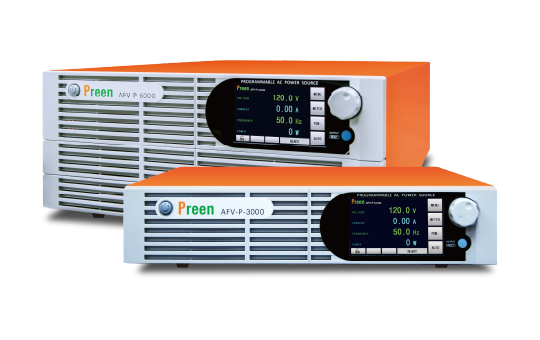 | Programmable AC power source with DC output and precision measurement. | 600VA~6kVA | 0~155V; Upgraded ver. 0~175V(Low Range) 0~310V; Upgraded ver. 0~350V(High Range) | A ver.: 5~2000Hz B ver.: 15~1000Hz | ≤ 0.3-2% | ≦ 0.07% F.S. | ≧ 77%-80% at max. power | 0-40℃ | - | - | ≧ 3 | ≧ 4.5 times of max.output current (rms) | ≦ 300 μs | 0~210V / 0~420V; Upgraded ver. 0~240V / 0~480V | Standard: RS232, RS485, Ethernet, USB, PLC Remote In& Out Option: GPIB, Analog | 16~61.5kg (35.3~135.6lbs) | CE & RoHS |
| AFV+ Series High Power Programmable AC Power Source | 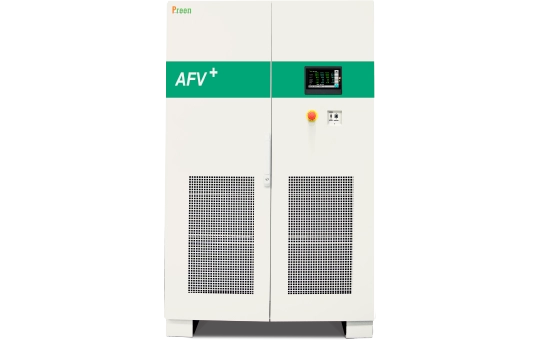 | An upgraded high power programmable AC power source of AFV series, with improving THD and Load Regulation. | 10kVA~2000kVA | 0~155V (Valtage Ranges Low) 0~310V (Valtage Ranges High) | A: 45~500Hz B: 45~120Hz C: 300~840Hz | ≦ 0.5% | ≦ 0.5% | ≧85%-90% at max. power | 0℃-45℃ | - | - | ≧ 3 | - | ≦ 1ms | - | Standard: RS232, RS485, Ethernet Option: Interface Card(RS232& RS485, Ethernet, USB) GPIB, Analog | - | CE & RoHS |
| AFV Series High Power Programmable AC Power Source | 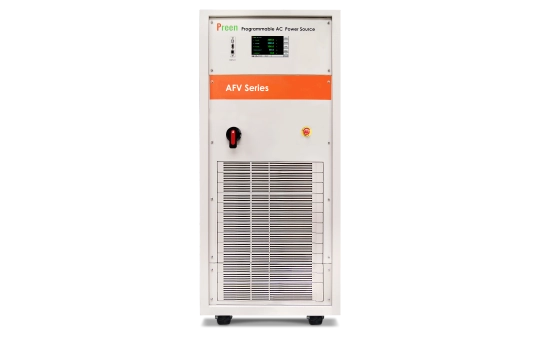 | High power programmable AC power source utilizing advanced PWM technology to deliver power. | 10kVA~2000kVA | 0~150V (Low range) 0~310V (High range) | 45~120Hz 45~500Hz (Opt.) | ≦ 1% | ≦ 1% | ≧85%-90% at max. power | 0℃-45℃ | - | - | - | - | ≦ 2ms | - | Standard: RS232, RS485, Ethernet Option: Interface Card(RS232& RS485, Ethernet, USB), GPIB, Analog | - | CE & RoHS |
| PAS/PFV Series Regenerative Grid Simulator | 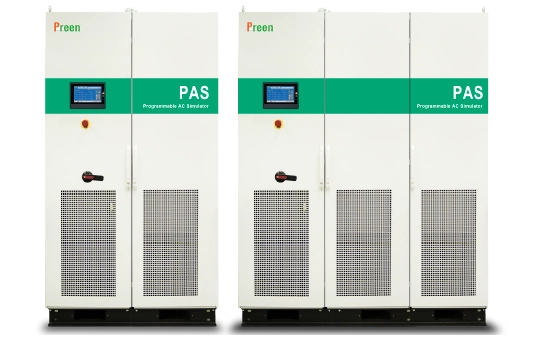 | Regenerative high power AC power source, built in with Low Voltage Ride Through Test (LVRT) test function. | 30kVA~2000kVA | PAS: 0-300V PFV-Low Voltage: 0-150V PFV-High Voltage: 0-300V | 45~65Hz 40~70Hz (Opt.) | ≦ 2% | ≦ 1% | ≧ 92% at Max. Power | 0℃-45℃ | - | - | - | - | ≦ 2ms | - | Standard: RS232, RS485, Option: Ethernet, GPIB, USB | - | CE & RoHS |
| AFC Series AC Power Source / Frequency Converter | 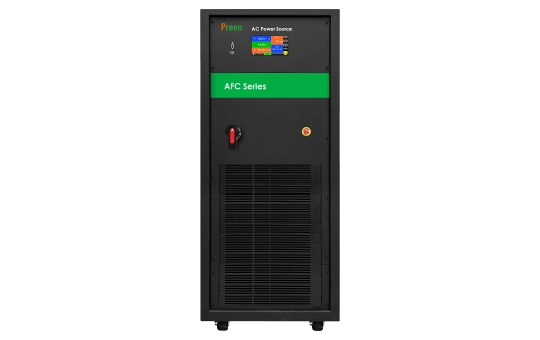 | AC power source which can simulate standard or abnormal voltage and frequency status. | 10kVA~2000kVA | 0~150V (Low range) 0~310V (High range) | 45~65Hz, 100Hz/120Hz/200Hz/240Hz/400Hz (Opt.) | ≦ 2% | ≦ 1% | ≧85%-90% at max. power | 0℃-45℃ | - | - | - | - | ≦ 2ms | - | Standard: RS232, RS485 | - | CE & RoHS |
| AMV/AMF Series 400Hz Power Supply / Ground Power Unit | 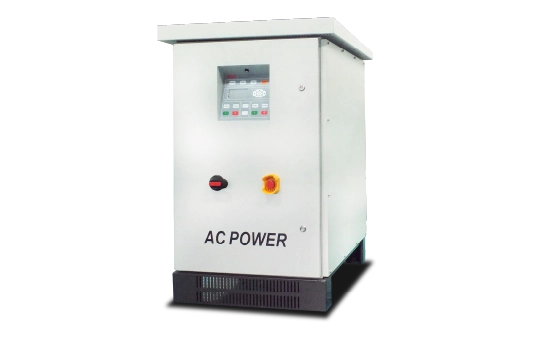 | Ground power unit which is compliant with MIL-STD-704F. | AMV: 30kVA~180kVA AMF: 500VA~400kVA | 115 / 200V or 115/200V ±10% | AMV: 300~500Hz(Stand Alone) 400Hz(Fixed) AMF: 350~450Hz 400Hz (Fixed) | AMV: ≦ 2% AMF: ≦ 0.5-3% | AMV: ≦ 1% AMF: ≦ 0.5-1.5% | AMV: ≧ 92% at Max. Power AMF: ≧ 87% at Max. Power | AMV: -40℃-55℃ AMF: -20℃-45℃ | AMV: IP54 | AMV: 125%/600s, 150%/30s, 200%/10s, (Optional) 150%/60s, 200%/30s, 250%/10s, 300%/1s AMF: 120%/1 hr, 150%/60s, 200%/15s | - | - | - | - | AMV: RS-485 AMF: RS-485 (opt.) | -- | CE & RoHS |
An AC power supply typically comprises a transformer, rectifier, and filter. The transformer adjusts the input voltage, the rectifier converts it into pulsating DC, and the filter smooths the output to provide usable power to the load.
Standard AC operating voltages are typically 220V and 380V, depending on regional requirements.
An AC power source is fundamentally a method of delivering energy from power generation stations to end-users. It is versatile and essential for both residential and commercial power distribution due to its ability to transform and travel efficiently.
There are two broad categories:
A programmable AC power source allows users to control voltage and frequency dynamically to simulate different power grid conditions. It can be operated remotely using digital interfaces like RS232, USB, GPIB, or analog inputs.
Which AC Power Source Is Suitable for EVSE Testing?
Preen’s AFV+ and PAS series can conduct various input and performance tests for EV chargers. The AFV+ series handles variable input simulations, while the PAS series is capable of power sourcing and sinking for regenerative testing.
Founded in 1989, Preen brings over 35 years of expertise to the power testing industry. Built on core power electronics technology, Preen provides programmable AC and DC power solutions for customers in renewable energy, electronics, and laboratory applications.
With production and technology hubs in Taiwan, Suzhou, and Tianjin, Preen integrates R&D, validation, and manufacturing capabilities to support stable and efficient testing needs. Through close collaboration with global strategic partners, Preen continues to expand its international service network and provide real-time support for customers worldwide.
Preen’s commitment to quality is reflected in its certified manufacturing and product compliance. Its manufacturing facilities are annually certified to ISO 9001:2015 standards, and core product lines are fully CE certified and compliant with EMC and LVD directives. Preen also strictly enforces RoHS compliance, ensuring that components meet hazardous substance regulations.
In addition, many of Preen’s recently launched programmable power products have received the Taiwan Excellence Award, reflecting the company’s continued focus on innovation, quality, and service. From product development to after-sales support, Preen is committed to delivering reliable power testing solutions that help customers maintain performance, safety, and long-term operational stability.