
AI Server
Is Your CDU Ready for the Heat? AI Server Cooling Validation with Preen
2026/04/29View

2026/05/27
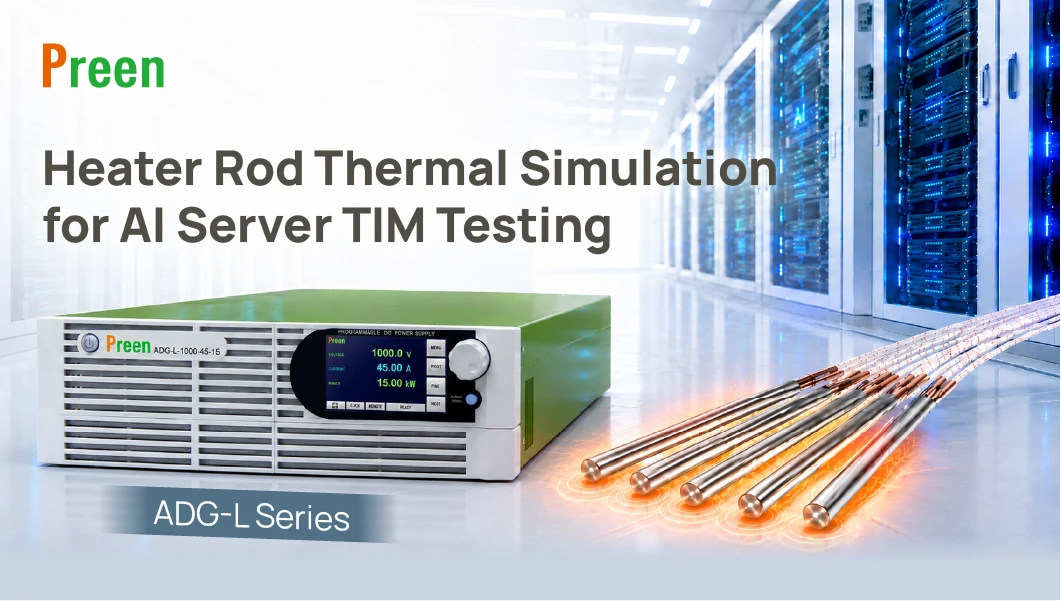
When validating thermal interface material (TIM) performance for AI server applications, using actual GPU hardware is often impractical. It is expensive, hard to control, and not built for long test cycles. Heater rods give you repeatable, adjustable heat output, but only if the power supply behind them is stable enough to matter.
This was the challenge faced by the customer.
The Setup
The customer develops thermal interface materials for AI server applications. Their goal was to build a laboratory environment that could simulate realistic server thermal conditions over extended test durations, allowing them to evaluate TIM performance under sustained thermal loading rather than short-term temperature spikes.
They needed to drive 12 heater rods simultaneously, each at different power levels:
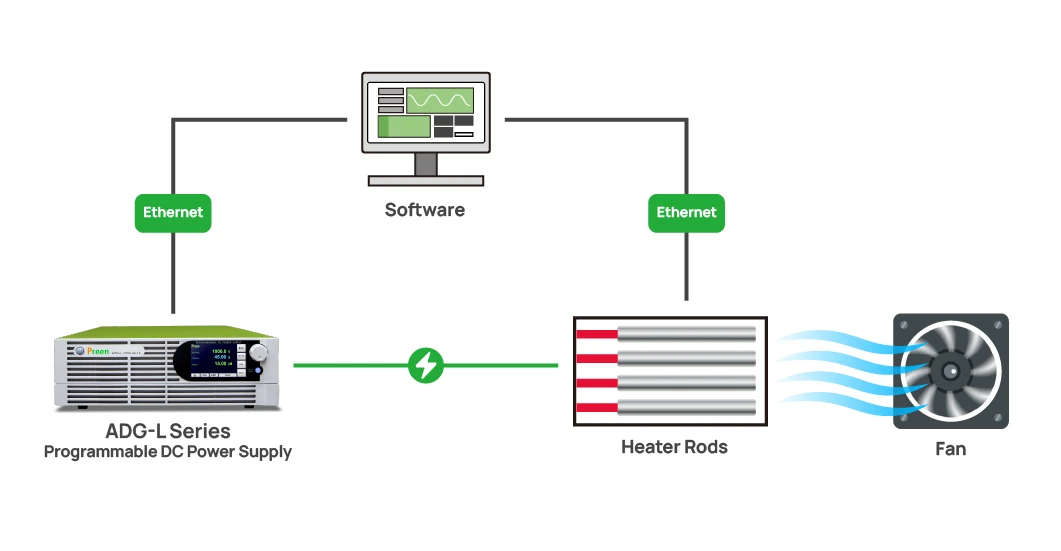
*PC-Controlled Heater Rod Test Chamber (Ethernet Connections to ADG-L & Enclosure with Fan Cooling)
All heater rods operate at DC 220V. Tests run continuously for around 4 hours. Each heater rod also requires independent power control, since thermal distribution inside actual AI servers is not uniform. Different zones operate under different thermal loads.
Customer’s solution: 3 units of the ADG-L-335-45-5, configured in parallel to cover the full load.
How the Test Actually Runs
Getting a thermal simulation to behave like a real server takes more than just turning on the heat. The customer designed a test sequence that mirrors how an AI server actually ramps and stabilizes.
During the initial heat-up phase, they run in constant voltage (CV) mode to bring the thermal environment up to target temperature quickly. Once the system hits the specified condition, they switch to constant current (CC) mode. This holds heat output steady and keeps temperature variation low during the measurement window, which is where data quality matters most.
For specific thermal load scenarios, constant power (CP) mode gives them direct control over the thermal load. For example, they can set a 4 kW heater rod to output at 3 kW to simulate a particular server component running at a defined power condition, without swapping hardware.
All three ADG-L units are managed through host software over RS-485. Test engineers can set power levels, switch output modes, and run automated sequences from a single interface, including auto-shutoff automatic shutdown when a target temperature is reached.
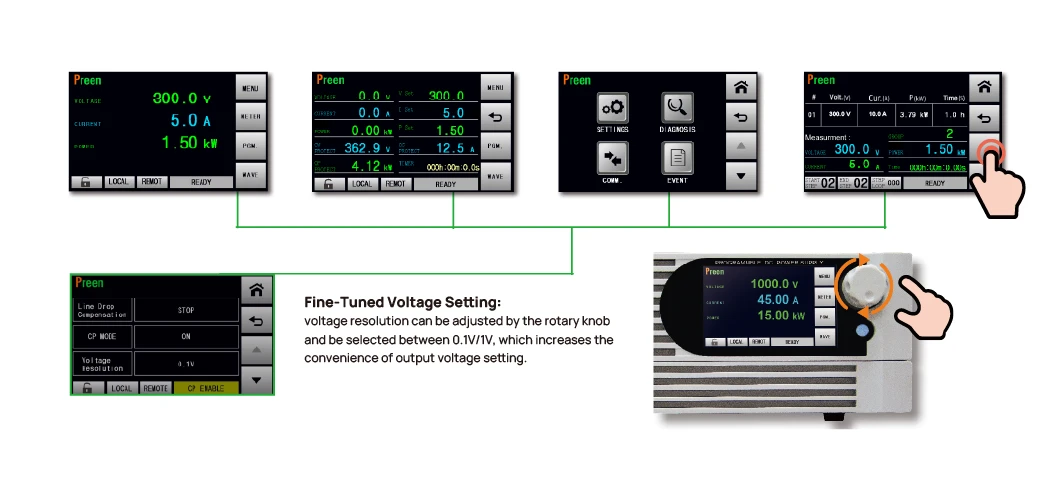
*The color touchscreen and jog dial provide direct access to settings, with adjustable voltage resolution (0.1V or 1V) for precise and convenient output control.
Why Power Stability Matters More Than It Sounds
In TIM testing, the core metric is thermal resistance, which is highly sensitive to output fluctuations. If the heater rod output drifts during a run, you cannot tell whether you are looking at a material characteristic or a test artifact.
The ADG-L's output stability kept that variable off the table. Even with longer cable runs between the power supplies and the test fixtures, voltage drop stayed within a range that didn't affect measurement consistency. The 19-inch 3U form factor also meant the three units fit cleanly alongside the temperature and humidity chamber and the customer's custom test fixtures, simplifying integration within limited laboratory space.
Error logging and the built-in protection functions gave the team confidence to run unattended overnight sequences without requiring continuous operator supervision.
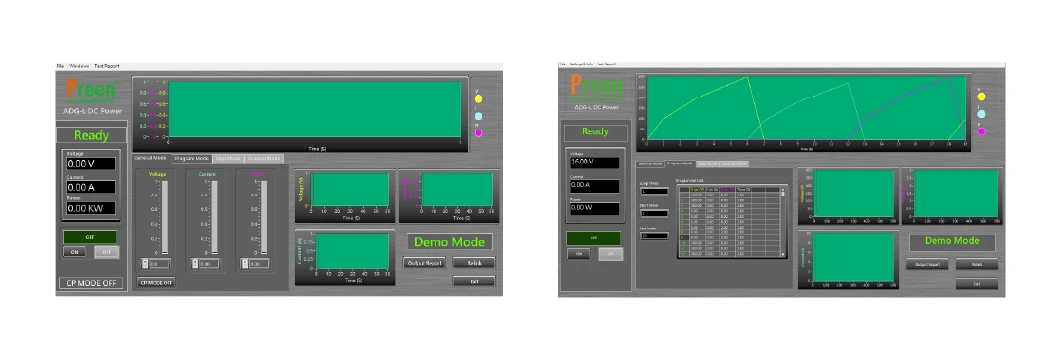
*Configure voltage, current, and power test sequences with real-time waveform monitoring through Preen Program. No additional software required.
What This Looks Like as a Broader Trend
This customer's setup reflects something that's becoming more common in thermal testing labs. As AI server power levels keep climbing, heater rod simulation is increasingly the practical path for liquid cooling validation, TIM characterization, and long-duration reliability testing before anything goes near actual server hardware.
The ADG-L, combined with application-specific heater rods and test fixtures, gives engineering team a thermal validation platform that closely replicates real operating conditions to generate results they can act on, and flexible enough to adapt as test requirements evolve.