
Making IEC 60601-1 Tests Repeatable: Why Programmable AC Power Matters
2026/03/18
In IEC 60601-1 electrical safety evaluation, input power is not just a utility. It is a test variable. If voltage, frequency, or waveform quality shifts during measurement, teams can end up troubleshooting the power source instead of the device under test, creating inconsistent results and avoidable retest loops. IEC 60601-1 is widely treated as the baseline safety framework for medical electrical equipment because it links design controls to verification evidence for basic safety and essential performance. For R& D and compliance teams, the practical requirement is repeatability across test runs, setups, and evaluation stages.
Power Quality Matters: Three Practical Reasons
1. Measurement integrity
Leakage and protective earth related measurements can be sensitive to waveform distortion and regulation drift. Clean, low-distortion output helps ensure readings reflect the product rather than supply artifacts.
2. Deterministic stress sequences
Mains variation, overload, and abnormal condition evaluations confirm safety margins under controlled stress. If the source cannot hold conditions consistently, it becomes difficult to separate device behavior from input instability.
3. Fewer false failures on high-transient loads
Large inrush and fast load transients can cause voltage sag or waveform deformation when the source lacks headroom. This may trigger nuisance protections and interrupt the intended test sequence.
Typical test workflow: Inrush current at power-up
High-power medical electrical systems, especially fixed X-ray platforms and related subsystems, can draw substantial inrush current during energization due to transformers, bulk capacitors, and internal power stages. Test teams typically lock nominal voltage and frequency, apply a controlled turn-on method, and capture peak current together with the corresponding voltage response.
Key observations include peak current magnitude, startup voltage sag, repeatability across multiple power cycles, and abnormal behavior such as unexpected resets, nuisance trips, or atypical thermal stress. A source with sufficient headroom and clean output helps keep the input deterministic so results reflect true power-up behavior.
Typical test workflow: Overload and abnormal mains conditions
IEC 60601-1 evaluations commonly include operation near rated load while applying defined mains variations to confirm protective behavior and safety responses. In practice, teams operate the device near its intended envelope and run controlled sequences such as voltage and frequency deviations within specified limits, monitoring protection response, stability of essential functions, and safety-related outcomes.
Stable regulation and repeatable programmability support consistent runs across iterations and reduce inconclusive results caused by input drift, especially on systems with multiple power domains and layered protections.
What to look for in a programmable AC source for IEC 60601-1 work
Selection criteria typically include:
• Sufficient headroom to avoid sag under inrush and transient loading
• Low waveform distortion to support accurate electrical safety measurements
• Wide voltage and frequency coverage to simulate global mains conditions
• Repeatable programmability and automation interfaces for efficient execution
One example configuration
One of our customers needed a power platform to support IEC 60601-1 sequences for fixed X-ray systems and related subsystems, including controlled power-up (inrush) and overload or abnormal mains condition testing.
In this system, image acquisition runs at a fixed cadence of about one shot every two seconds. Each exposure drives a repeatable step-load event at the AC input as the generator recharges internal energy storage and performs high-voltage conversion. This creates frequent current swings rather than a steady-state load.
To keep IEC 60601-1 sequences repeatable, the input source must maintain tight regulation and waveform quality through these transitions, so measurements and observed behavior reflect the device under test, not supply-side sag, distortion, or nuisance trips.
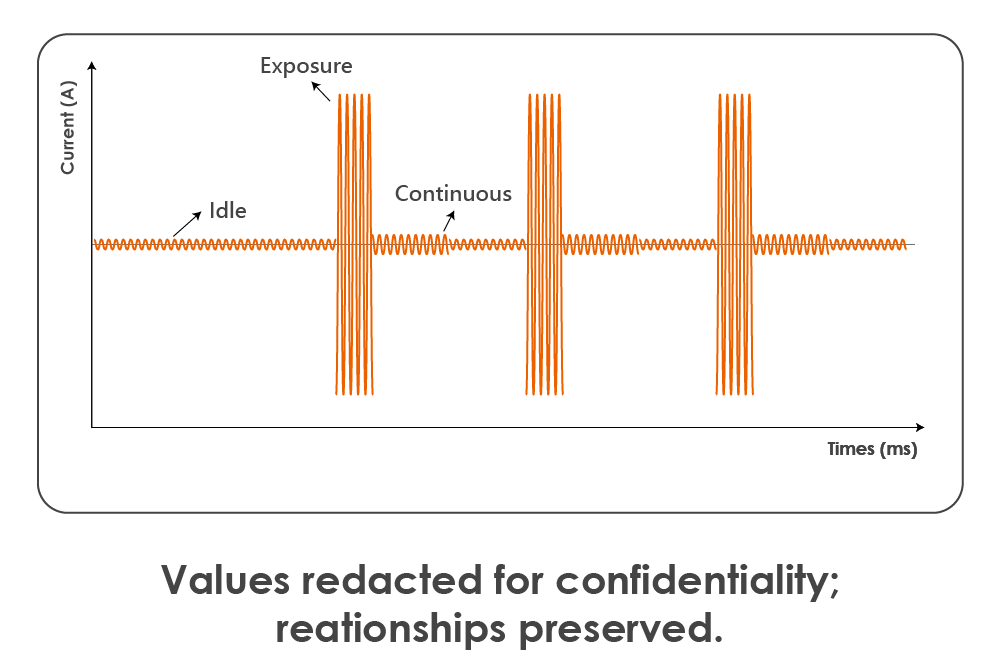
Caption: Values redacted for confidentiality. The system is a high-power three-phase load with current demand that scales with line voltage, making regulation and waveform quality critical for repeatable IEC 60601-1 sequences.
Two programmable sources were used to cover both high-power 3-phase operation and single-phase or DC-related tests:
• AFV-33120: 120 kVA 3-phase programmable AC source, up to 333.3 A
• AFV-P-6000B: programmable AC/DC source up to 6000 W
Programmable power to support repeatable IEC 60601-1 sequences Best-fit coverage for inrush, mains variation, and overload/abnormal condition workflows, across both high-power 3-phase systems and single-phase or DC-related tests.
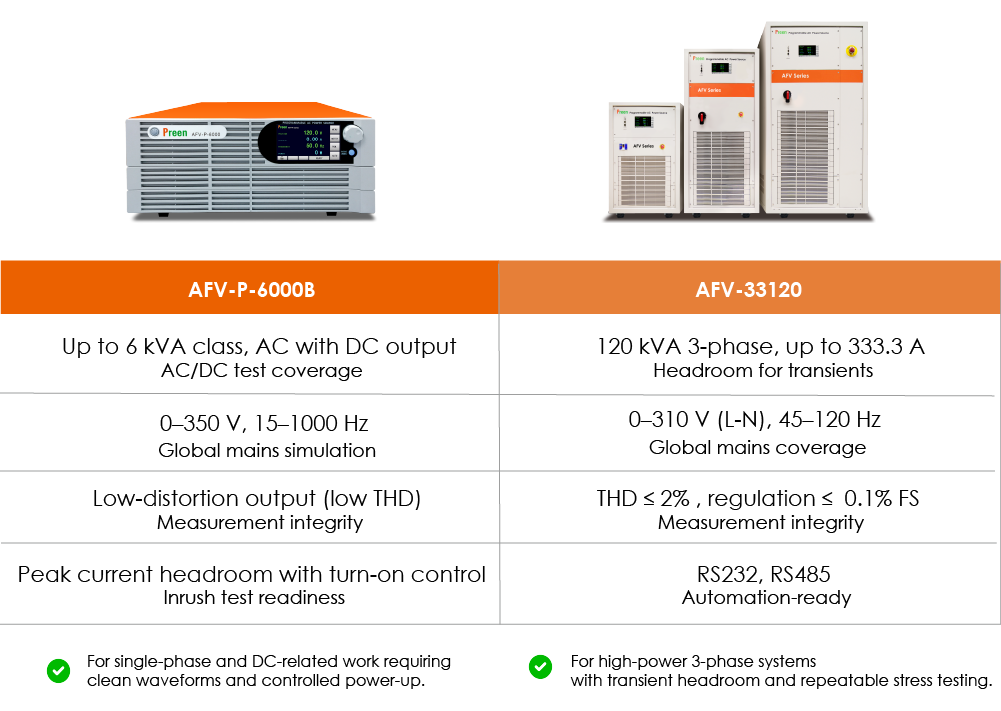
Example configuration, final spec depends on model/options.
You’re welcome to share your IEC 60601-1 test conditions, such as the required voltage and frequency ranges, load profile, and inrush/abnormal test requirements, so our engineering team can quickly align the right configuration and test settings for your setup.